Chapter 1
The Convict Ship
Betsey Maxwell wearily trailed behind Loren as her brother dodged the muddy puddles, horse manure, and piles of crates in the narrow London street. Her feet were already cold and wet as water seeped through the holes of her thin leather shoes.
"Hurry up, Betsey!" Loren urged, grabbing her hand. "We’re almost at the docks. We gotta get there before they bring the prisoners." Loren was twelve—two years older than Betsey. It had been his idea to come to the docks along the River Thames this morning to try to see their mother.
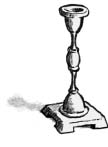
Betsey tried to hurry. But a terrible dread in the pit of her stomach made her want to turn and run back the other way. It had been four months since she’d seen her mother. All because of that stupid silver candlestick! Betsey thought fiercely.
She wished Mama had never gone to that fancy house on Fleet Street to collect the washing. Taking in washing was how Mama tried to make a living, and the people in the fancy house were new customers. But the first time Mama had delivered the basket of freshly scrubbed sheets, pillow covers, and underclothes to Fleet Street, the housekeeper sniffed that the clothes weren’t done properly and refused to pay her.
Mrs. Maxwell had climbed the rickety stairs to their two tiny rooms in the crowded tenement house muttering angrily, "Ain’t gonna let them rich snobs rob my babies." Betsey noticed her mother was carrying something wrapped in her shawl. She quickly stuffed the package under her mattress. Late that evening, loud shouts and rough laughter from the gin house next door woke Betsey, and she saw her mother slip out into the noisy night with the shawl-wrapped bundle.
But Mama never came home. Instead, a clegyman dressed all in black knocked on their door the next day and told Loren and Betsey that a thief-catcher had caught their mother trying to pawn a stolen candlestick, and she’d been taken to Newgate Prison.
The clergyman had wanted to take the children to the parish workhouse to await their mother’s fate, but Mrs. Hinkley, their upstairs neighbor—a loud woman with painted eyes and red lips who usually slept all day and was out all night—had hotly protested and taken the children up to her own flat. That night a frightened Betsey had cried herself to sleep, huddled on a lumpy straw tick with Mrs. Hinkley’s three runny-nosed children. What was going to happen to Mama? What was going to happen to her and Loren?
That was four months ago. Only last week Mrs. Hinkley had gone to the prison and discovered that Kate Maxwell had already been tried and sentenced to "transportation."
"Transportation? You mean . . . she’s being exiled to Botany Bay?" Loren had said, his face white under the shock of unruly brown hair.
"Yeah," said Mrs. Hinkley, slumping into a chair by a rough wooden table and uncorking a half-empty bottle of gin. "Better than hangin’," she’d muttered, more to herself than to the frightened children.
Somehow Loren had found out when the prisoners who had been sentenced to "transportation" were being taken from Newgate Prison down to the "convict ships" for their long voyage to Botany Bay. Botany Bay was the place England sent its "criminal class"—a dreaded destination in that wild land called New South Wales on the other side of the world. (New South Wales was a territory on the continent later known as Australia.)
But now as Loren pulled his sister along the docks flanking the River Thames, Betsey’s mouth dropped open in dismay. She had thought there would be just one ship at the dock. But a whole row of sailing ships with their tall masts and webs of rigging were moored to the docks with long, heavy ropes. Several more ships were anchored out in the middle of the river. Dockhands were busy loading barrels, live animals, and crates onto some ships and unloading others. Soldiers in bright red coats were saying goodbye to mothers and sweethearts before boarding several troop ships bound for Europe, where the English and their allies were fighting the feisty little French emperor, Napoleon.
"Oh, Loren!" Betsey cried. "How will we ever know which ship they’re to put Mama on?"
Loren didn’t answer because just then a shout went up from the deck of one of the ships. "Look out, mates! Here they come!" Turning their heads in the direction the deckhand was pointing, Loren and Betsey saw a large, noisy crowd of people coming toward the docks.
"Come on," Loren hissed, pulling Betsey to a spot where the crowd would have to pass them. As the throng came closer they saw not one, but many open wagons, some filled with women, others with men. Running alongside were men, women, and children shouting and jeering at the wagon’s occupants.
"Thieves and scoundrels, the lot o’ ya!"
"Ha, ha! Good riddance, I say!"
"That’s right. Get rid of the criminal class in England. Send ’em all to Botany Bay!"
"Want some food for the voyage, dearie? Here!" A rotten tomato sailed through the air and landed—(splat!)—right on the ear of an angry female prisoner.
The occupants of the wagons weren’t quiet, either. Shackled together with chains, many of them yelled back at their tormentors, spitting and cursing.
The first wagon of women went by so fast and the crowd around it was so thick that Betsey didn’t get a good look. "Did you see her, Loren?" she asked anxiously. Loren didn’t answer. He was busy scanning the coming wagons.
"There she is!" he finally cried, pointing to a wagon crammed with women prisoners. "See her, Betsey?" Loren grabbed his younger sister around the waist and lifted her up to see over the crowd.
Betsey’s heart was pounding beneath her gray shift and pinafore. At first she couldn’t tell which one was Mama. Then she saw Kate Maxwell, looking frightened and bewildered at the crowd of people yelling and jeering all around her.
"Mama!" Betsey screamed. "Mama! Over here!"
But Mrs. Maxwell just stared straight ahead as if she hadn’t heard . . . and in the next moment the wagon rumbled out onto the docks.
"Come on," Loren commanded, once again grabbing Betsey’s hand and running after the wagon. The two children tried to keep up, but they had to dodge this way and that to keep from being knocked down by the unruly crowd. The wagons carrying the women prisoners had pulled up beside one of the ships swaying gently at the riverside dock; the wagons carrying men and boys rattled on down the docks to another ship farther away.
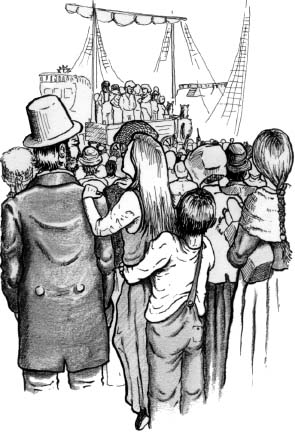
By the time Loren and Betsey pushed their way through the crowd, the first wagons of women had been emptied and the prisoners were being led up the gangplank onto the decks. Frantic, Betsey scanned the figures of the women going on board.
"Mama!" she screamed, hoping her mama would hear. "Mama!" Several women turned to look at her—was one of them Mama? Yes! There she was. She was looking . . . looking—but just then the line of women stepped off the gangplank and disappeared behind the tall bulwarks surrounding the ship’s decks.
The heckles of the rowdy crowd still filled the air.
"Transportation’s too good for that lot," complained a raspy voice. "Shoulda hung ’em all, if ya ask me."
"Oh, I don’ know," said another. "I heard that Botany Bay is the gateway to a living hell."
"Yeah, heh, heh. Full o’ savages with spears an’ dry, hot desert as far as the eye can see . . ."
Hot tears sprang to Betsey’s eyes. Why were the people so mean? Why was the judge sending her mother away? Would she ever see her again? And what were she and Loren going to do now?
Just then a hand touched her shoulder. Startled, Betsey looked up into the face of a woman. "Is thy mother going on that ship?" the woman asked gently.
Instinctively, Betsey shrank away and stared. The woman was wearing a plain black dress and matching cloak, but they rustled as if they were made of silk. Kind gray eyes peered out from under a black bonnet, which framed a pleasant face.
"It’s none of your business!" Loren snapped, stepping between his sister and the strange woman.
"Please," the woman said, "I don’t mean thee any harm—"
"Come, come, Elizabeth," said a man’s voice. Betsey realized the woman was accompanied by a man also dressed plainly in black stockings and breeches and a long, well-made black coat.
"But, Joseph!" the woman cried. "I had no idea such things went on in our own city. Mothers torn away from their children, citizens harassing these unfortunate prisoners who may never see their loved ones again. When Friend Grellet told me to witness the transportation of women prisoners for myself—"
"I know, Elizabeth," the man said quietly. "It is very distressing. But thee can’t do anything here. It’s out of thy hands for the moment. Come."
Betsey watched as the man led the woman away. She continued to look back over her shoulder at the children. Betsey was sorry she and Loren had been so rude. The woman had been the only kind voice in this pushing, shoving, jeering crowd.
Just then another raspy and mocking voice caught her ear. "Heh, heh. Did ya hear that, Pigeye? Tsk, tsk. Those high ’n mighty Quakers think shipping this criminal cargo to Purgatory is ‘so distressing.’ "
Betsey wiped the hot tears from her cheeks and pulled closer to Loren. Two young soldiers lounged a few feet away against a big packing barrel, gaping at Loren and Betsey.
"Huh!" said the one named Pigeye. "They should ship the prisoners’ brats to Botany Bay, too. Be done with ’em, once and for all."
"Nah, I got a better idea," said the one with the raspy voice. He pushed himself off the barrel and took a step toward Loren and Betsey. "Them two young’uns ain’t got no place to go, now, do they?" he said to his buddy. "Their lowdown mama’s on that ship an’ ain’t comin’ back, now, is she? An’ that girl is a purty little thing, wouldn’t ya say, ol’ chap?"
Before the young soldier with the raspy voice could take another step, Loren grabbed Betsey’s hand and started running away from the dock. Frightened, Betsey ran hard to keep up, forgetting the sores on her feet caused by her damp, torn shoes. As they dodged another wagon full of arriving prisoners, Betsey looked back over her shoulder. The two young men in red coats were still standing on the dock, laughing heartily, watching them go.
As Loren and Betsey reached the narrow street leading away from the riverside, the boy slowed down, then stopped. He looked back at the row of ships, their masts swaying like a forest of trees in the damp breeze blowing off the River Thames.
"Don’t you worry, Betsey," Loren said fiercely, putting an arm awkwardly around his sister’s shoulder as they started slowly back toward Mrs. Hinkley’s flat. "I’ll take care of you—no matter what!"
It was midmorning when the children arrived back at the flat in one of London’s slums. They tiptoed up the squeaky stairs and pushed open the door as quietly as possible because Mrs. Hinkley usually slept till noon.
But Mrs. Hinkley had a visitor.
© 1995 Dave and Neta Jackson